
Heat Pump Hot Water Sunshine Coast: Sizing, Placement and Running Costs
Sick of paying to heat water with an old electric tank? A heat pump can cut that cost, as long as it is sized and placed for your home.
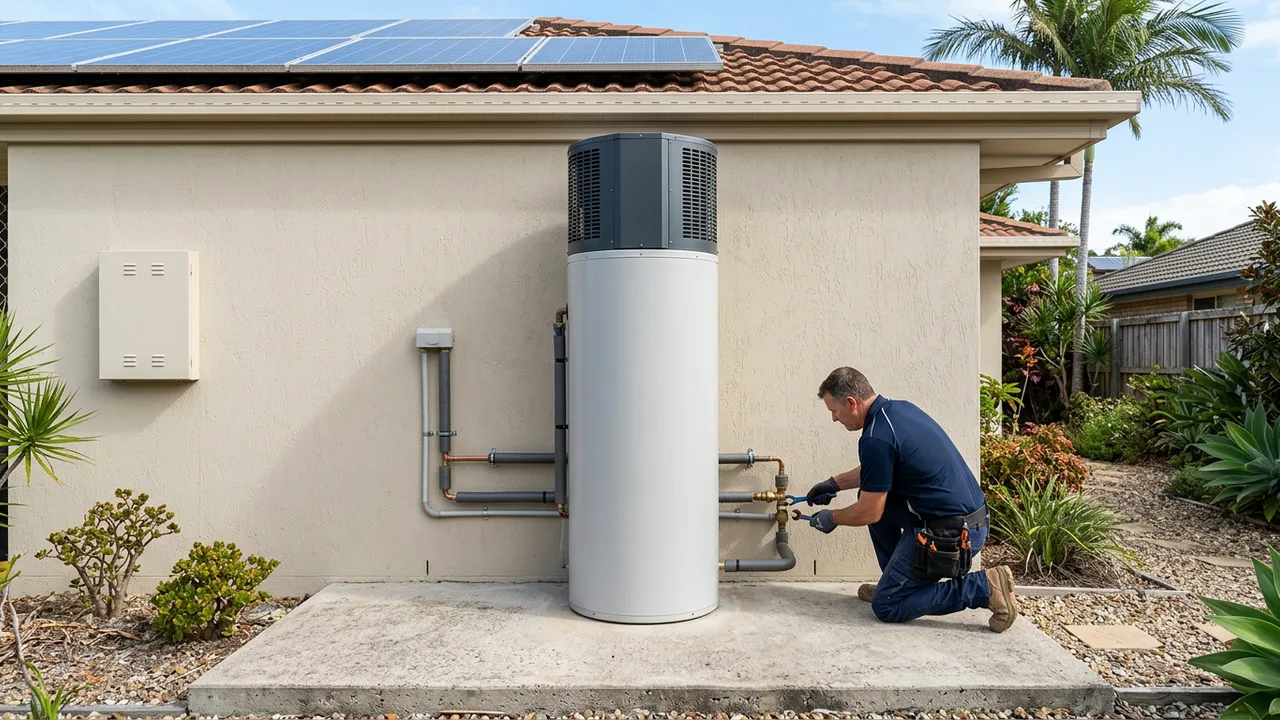
Heat pump hot water on the Sunshine Coast makes sense for many electric households, because the mild coastal climate keeps these systems working efficiently all year. There is no element doing the heating. It pulls warmth out of the surrounding air with a fan and compressor, much like a reverse air conditioner, and moves it into the tank. A good one needs only around a third of the power an element tank uses, which is where the savings come from.
What is included
- Sizing the tank An undersized tank leaves the last person with a cold shower, and an oversized one heats water that sits unused.
- Choosing all-in-one or split An all-in-one unit sits outside as one piece. A split puts the tank in one spot and the fan unit in another, which helps in tight spaces.
- Placement for noise and air The fan needs open air to work and should sit away from bedroom windows, yours and the neighbours'.
- Timer or tariff setup A built-in timer set to the middle of the day lets rooftop solar do the heating, while some homes keep a controlled load circuit.
- Coastal protection Near the beach, a sheltered position or a coastal-rated model protects the fins and casing from salt.
How it works
-
Household and power check
How many people shower at home, any rooftop solar on the roof, and the tariff the current tank runs on.
-
Site check for placement
Airflow around the spot, distance from bedrooms and exposure to salt air are looked at before a model is chosen.
-
Quote with the STC discount
The quote names the model, tank size, timer setup and the STC discount applied at the point of sale.
-
Install and set the timer
The unit is fitted, the tempering valve set, the timer programmed and the Form 4 lodged with the QBCC.
Is a heat pump right for your household
This kind of system suits you best when you run an electric tank now, use a fair amount of hot water and have rooftop solar or plan to add it. In those homes the running cost drops sharply, because the system needs only a fraction of the electricity an element tank uses and can draw that from your own panels in the middle of the day.
It suits you less when the household is one or two people with low use and no solar, or when the only possible spot is a closed cupboard or garage with little airflow. The upfront price is higher than a plain electric tank, so the saving takes longer to repay in a light-use home. If the old tank has just failed and you need hot water tonight, our hot water system replacement page covers the quick swap and when to plan the upgrade for later.
Heat pump running costs on the Sunshine Coast
The saving depends on when the heat pump runs and what it runs on. Rooftop solar peaks around the middle of the day, so a common setting is for the unit to come on at about 11 am and run for three to four hours. That solar timer setup is why a heat pump comes out so far ahead of an electric tank for homes with panels. While running, the unit draws roughly 500 to 1,000 watts, which most home solar systems can cover.
Some households keep the unit on a controlled load circuit such as Energex Tariff 31 instead. That works for some models, but check the manual, because a few heat pumps do not like having power cut mid-cycle. If you have solar, a daytime timer usually costs less to run than the overnight tariff.
Noise, placement and the neighbours
Owners describe heat pumps in very different ways. Some call their units close to silent, while others say the hum reminds them of an air conditioner. Most models run in the low 40s decibels, with louder ones in the low 50s, against the mid 60s typical of an outdoor air conditioner.
Placement settles most of this. Keep the fan unit away from your bedrooms and the neighbours' windows, give it open air on the fan side, and run it in the daytime. On a narrow side path or a unit balcony, a split system lets the quieter tank sit close to the house while the fan unit goes where the sound matters least.
What a heat pump costs on the Sunshine Coast
For South East Queensland, the nearest published price list is for Brisbane, updated in November 2026. It puts an installed heat pump at:
- Before the STC discount: $3,000 to $6,000, with $4,200 typical.
- After the STC discount: $2,500 to $5,300.
- 250 to 270 litres, for one to three people: $3,000 to $6,000.
- 300 to 315 litres, for three to five people: $3,400 to $7,000.
That STC discount comes from small-scale technology certificates. Eligible models on the Clean Energy Regulator register create them, and the installer normally takes their value off your price at the point of sale. The number of certificates falls each year until the scheme ends in 2030, so the discount shrinks over time.
Rules, warranties and coastal care
Only a plumber who holds a solar and heat pump endorsement may fit a heat pump in Queensland, so ask to see that QBCC licence detail. Warranties differ widely by brand: compressor cover runs from 1 to 10 years and tank cover from 5 to 15 years, and a longer warranty is one of the better signs of a reliable unit.
If you live close to the beach, ask about coastal-rated models and a sheltered position, and hose salt off the fins with fresh water every few months. That simple habit protects the part most exposed to the sea air.
Heat pump hot water options
- All-in-one heat pump installation Tank and fan unit in one outdoor package, suited to homes with a clear side path or slab.
- Split heat pump installation Tank inside or under cover with a separate fan unit outside, handy for units and tight spots.
- Electric to heat pump upgrade Replacing an electric storage tank with a heat pump, including any circuit or timer changes.
Heat pump hot water across the Sunshine Coast
Frequently Asked Questions
What are the downsides of a heat pump hot water system?
How loud is a heat pump hot water system?
Can a heat pump run on my existing off-peak circuit?
Will a heat pump keep up in a cold hinterland winter?
Get it priced
Tell us your current system, what it is doing and your suburb, and get your hot water sorted.